 English
  French
  Dutch
Dutch  German

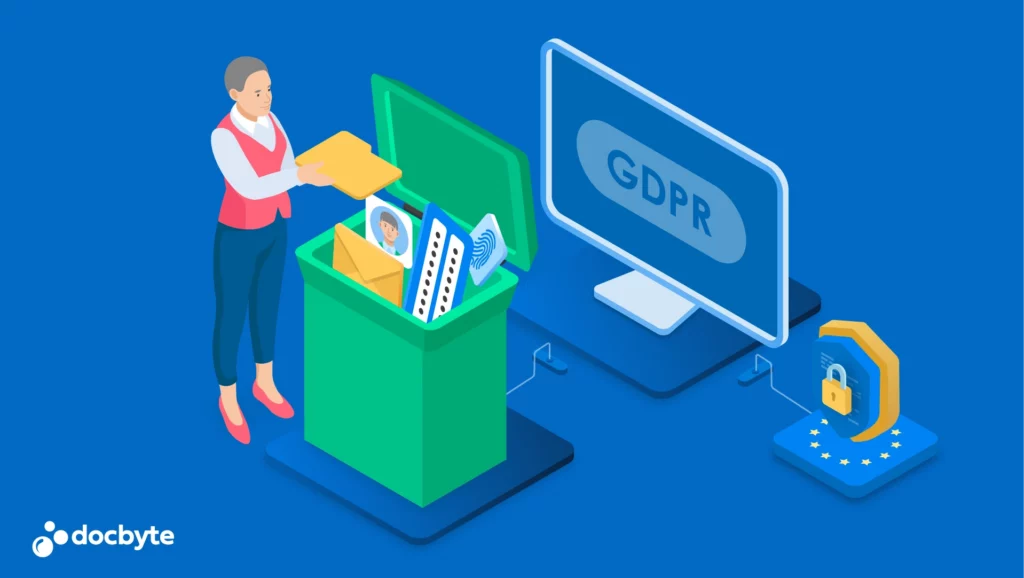
When the right to erasure meets retention obligations, a practical pattern with strict access controls, auditability, and lifecycle governance.
TL;DR:
In many cases you should remove personal data from operational systems to reduce privacy risk and limit processing. But GDPR is not always a requirement to destroy everything. If you have legal retention obligations or need to defend claims, you may be allowed to retain a minimal set of information in a tightly restricted archive, with clear purpose, strict access, and defined retention and deletion.
Why this often goes wrong
Many organisations swing between extremes. Either they keep everything forever, or they assume a delete request means immediate total destruction. GDPR requires a more controlled approach: minimise operational processing and still meet accountability, audit, and legal obligations.
The typical tension: you want to reduce attack surface and privacy exposure by removing data from production systems, but you still have retention duties, evidence needs, or ongoing disputes.
When you cannot fully delete
The right to erasure is important, but it has exceptions. Common scenarios where you may need to retain certain information include:
- Legal retention obligations (finance, HR, sector regulations).
- Legal claims and disputes (burden of proof, limitation periods, legal holds).
- Audit and accountability requirements (proving what happened, when, and by whom).
Key point: you retain data because you have a defined legal basis and a specific purpose, not because it is convenient. Validate the legal basis and retention rules with your DPO and legal counsel.
The pattern that works: delete in operations, retain in a restricted archive
A practical GDPR friendly approach often looks like this:
- Decide what is operationally required versus what is only needed as evidence.
- Delete, anonymise, or restrict processing in operational applications.
- Move the minimum necessary evidence to a restricted archive with stricter rules.
- Apply retention per record class and delete automatically at the end of retention.
What does restricted mean in practice?
A restricted archive is more than a folder with limited permissions. It should include:
- Purpose limitation: the archive does not become a new operational data source.
- Strong access control (RBAC or ABAC) with need to know.
- Audit trail of access and actions (view, export, deletion).
- Encryption and key management.
- Retention policies per record class with legal hold override.
- Search and retrieval for audits without reactivating legacy systems.
How to automate this safely
Step 1: define your record classes
For each record class, document:
- What do we need to find it later (minimum metadata)?
- What evidence must be preserved (audit trail excerpt, version history)?
- What is retention and what triggers destruction?
Step 2: minimise what you archive
Storage limitation means you should not keep more than necessary.
- Archive proof you need, not every optional field.
- Split attachments into required versus optional.
- Consider pseudonymisation and strict key access when feasible.
Step 3: make the archive defensible
If you expect audits or disputes, build evidence of completeness and integrity:
- Manifests and hashes for tamper evidence.
- Ingest and export logging.
- Repeatable export rules from the source systems.
Step 4: automate end of retention
A common GDPR failure is to archive once and then forget to delete. Build a lifecycle that includes:
- Policy driven retention per record class.
- Automatic deletion with proof of deletion.
- Legal holds governance for exceptions.
Where Docbyte Vault can fit
Docbyte Vault can support this pattern as a control layer: configurable ingest, strict access control, audit trails, and retention lifecycle management. You still need to define and document the legal basis and retention rules first.
FAQ
Q1: Can we keep personal data after a GDPR delete request?
Sometimes yes, sometimes no. It depends on your legal basis and applicable exceptions such as legal retention duties or claims. Validate with your DPO and legal counsel, and document purpose, scope, and retention.
Q2: What is the difference between archiving and hiding data?
Archiving is controlled, purpose bound retention with strict access and lifecycle rules. Hiding data without governance usually keeps it operationally available and increases risk.
Q3: How do we prove data is gone from operational systems?
With evidence based controls: deletion logs, data inventories, periodic checks, and clear separation between operational and archive stores.
Next step
To validate your approach, pick 3 to 5 record classes and have DPO or legal confirmation for each: what to delete or anonymise in operations, what to retain in a restricted archive, and retention plus legal hold rules. Then automate.
Sources:
GDPR (EU) 2016/679, official text on EUR Lex
https://eur-lex.europa.eu/eli/reg/2016/679/oj
Related Docbyte solution pages
Continue with the Docbyte solution pages that match this topic:


