French
 English
 Dutch
 German


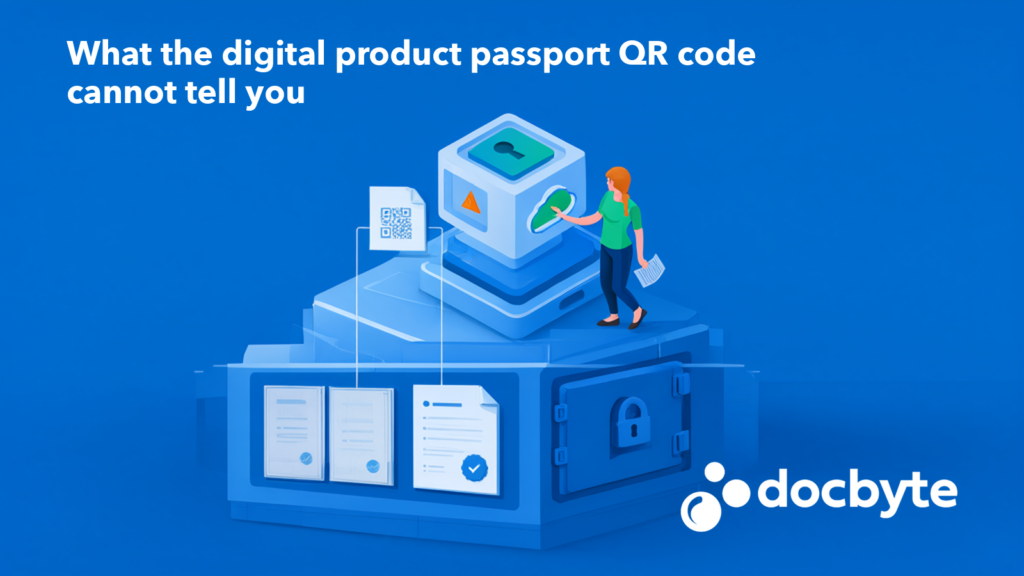
Most DPP platforms are built to publish data. Few are built to prove it.
From 18 February 2027, the Battery Regulation (EU) 2023/1542 requires a passport for every electric vehicle battery, light means of transport battery and industrial battery above 2 kWh placed on the EU market. Battery manufacturers are choosing their DPP platform now. Their questions are about cost per passport, integration with their production systems and how fast they can go live. Those are fair questions but they are also the wrong place to stop.
A platform that only displays data ends up being compared on price. The difference lies underneath the passport, in records that still hold up when something goes wrong.
The short answer
A digital product passport shows what is true about a product today. When something goes wrong, your customer is asked a different question: what was true then, and who said so? Answering it takes the original documents, kept exactly as issued, sealed by the party that created them, with proof that nobody has changed them since. That is what a trusted archive behind your platform adds.
Your customers’ passports will be questioned years from now
A digital product passport (DPP) is a digital record of one product, with separate parts for the public, for repairers and recyclers, and for authorities. It also has to last. A repurposed or remanufactured battery gets a new passport linked to the original one, and the passport only ends when the battery is recycled.
In that time, an authority may ask questions, an insurer may contest a claim, or the manufacturer may have moved to another DPP platform. The records behind the passport have to hold up either way.
A repair that did not follow the manual
Take a fictional case from our Docbyte Vault demo. Battery manufacturer Voltara publishes its passports through a DPP platform. On 25 August, it updates its repair procedure for one of its electric vehicle battery packs and informs all authorised repairers the same day.
One repairer keeps using the old version and repairs six packs that way. Shortly afterwards, three of them overheat, each in the part that was replaced. Each question that follows has a price if nobody can answer it:
- Who pays: Voltara under warranty, or the repairer?
- Which other packs were repaired the same way, and where are they now?
- Did the repairer receive the new procedure, and when did it first download it?
- Will the authority accept the records Voltara shows it?
One of the packs at risk has since been turned into stationary energy storage, with a new passport. The link between the two passports is the only way to find its new owner. Voltara’s first call goes to its DPP provider: show us what the repairer had in front of it in August.
What the passport cannot prove
The passport shows that a pack was repaired and overheated. It cannot show which procedure applied on the day, what the repairer had been told, or whether today’s documents are the ones that existed in August. To prove that, the records underneath the passport need five things:
- The old procedure is kept, unchanged, next to the new one. If the manual on the service portal is overwritten, nobody can show what the repairer was working from.
- The repairer seals its own repair report with an electronic seal under the EU eIDAS regulation. The seal links the report to the organisation that issued it and makes any later change detectable. It does not prove the report is correct, only who issued it and that nobody has edited it since.
- The passport, the repair report and the procedure are linked to each other in a way that breaks if any of them is swapped or edited.
- The archive regularly checks that every file is still identical to the day it was stored, and logs who opened which record and when.
- Each party sees only what it is entitled to. Repair data is not for the public, and what an authority can see depends on its legal mandate and the applicable access rules.
A DPP provider holds the data, but it cannot be its own witness. When Voltara and its repairer disagree, a record kept by the platform one of them pays for is a claim, not proof. An independent archive that validates every seal on arrival and timestamps what it receives turns the same data into evidence that neither party controls.
What the archive answered in the demo
In the demo, the DPP platform keeps publishing the passports. Behind it, Docbyte Vault receives the passports, both versions of the procedure, the portal download records and the repair reports through the Docbyte API. It validates every seal on arrival, preserves each file exactly as received together with the evidence of its integrity, and controls who can see what.
Then someone asks a question in plain language. An AI assistant connected to Vault finds the relevant records and summarises them. The evidence remains the archived records it points to, which a reviewer verifies.
The three overheating packs share neither a production batch nor software. They share a repairer that used an outdated procedure: it was informed on 25 August but only downloaded the new version on 14 October, after the overheating incidents. Three more packs carry the same risk, including the one now used for stationary storage. Every step of that answer points to a sealed record whose integrity an authorised reviewer can check.
What this changes for a DPP provider
Without that archive, the investigation runs on e-mails, screenshots and an argument about which PDF was online in August, and the DPP provider is asked to reconstruct what its own platform showed at the time, from its own logs, with its own credibility at stake. With it, the provider hands over sealed records that neither it nor Voltara could have altered without detection. Voltara can then limit the recall to six packs instead of a whole model and push back on the warranty claim with the repairer’s own sealed report. The manufacturer pays for a passport either way, so a provider that can also show how those passports hold up as evidence no longer competes on cost per passport alone.
A passport is seen by many people. It is tested by few, usually after something has gone wrong. So the better question for a DPP provider is not what its platform costs per passport. It is this: when one of your customers’ batteries overheats three years from now, what will they be able to prove?
Book a DPP demo
See the Voltara case run with Docbyte Vault behind a DPP platform, from the sealed repair reports to the one question that traces three overheating packs back to an outdated manual. We will also look at how Vault connects to your platform and which of your customers’ records need to hold as evidence.
Foire aux questions
Does Docbyte Vault replace our DPP platform?
No. Your platform publishes and updates the passport. Vault sits behind it, receives the records through the Docbyte API and preserves every version as received, with its seals, integrity evidence and access rules, so your customer can prove later what was true at the time.
Who owns the customer relationship?
You do. The manufacturer stays your customer. Docbyte works behind your platform as a partner.
What happens to the passport when a battery gets a second life?
The battery gets a new passport, linked to the original one, and responsibility moves to the company that places it on the market again or puts it into service (Article 77(7) of the Battery Regulation). The history only stays useful if the records behind the original passport remain available and verifiable.